

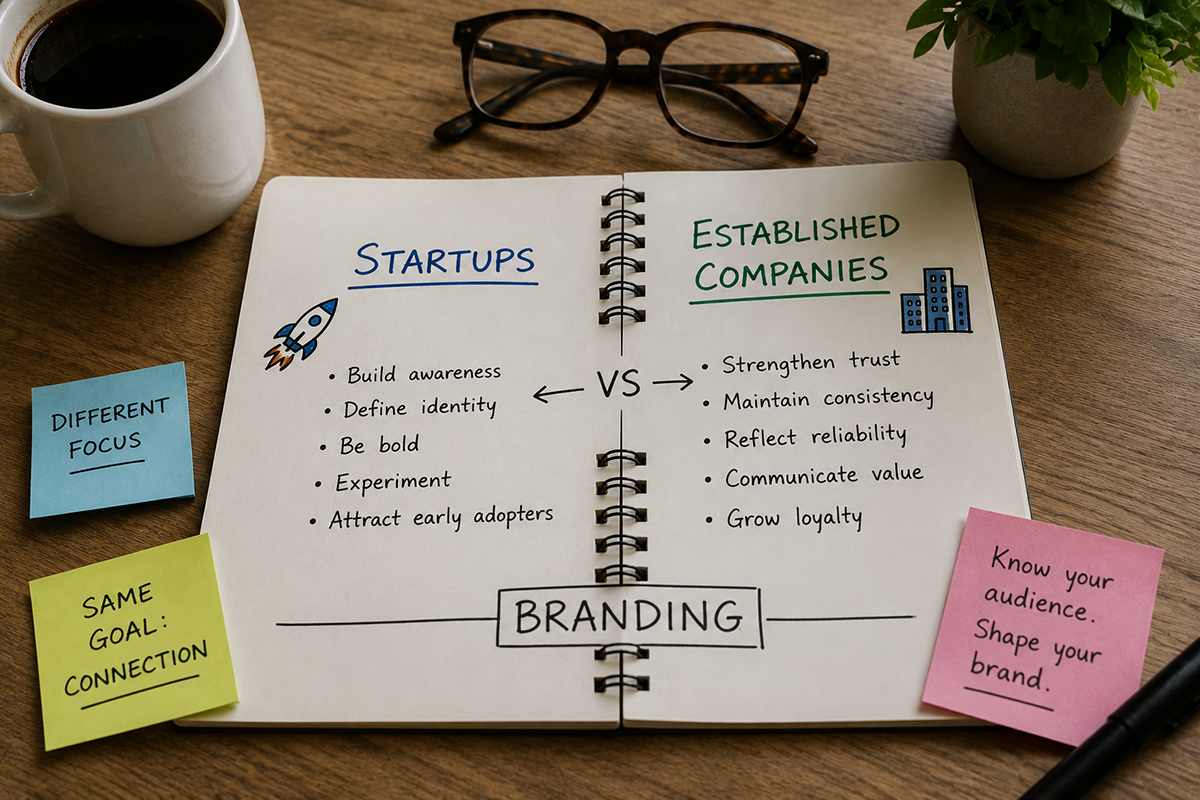
Every organisation needs a recognisable brand, but not every organisation needs the same branding strategy. A startup trying to enter the market faces very different challenges from an established company protecting years of awareness, reputation, and customer trust.
For a startup, branding is often about becoming visible, explaining a new idea, and creating enough confidence for customers to take an initial chance on an unfamiliar business.
For an established organisation, branding is usually more complex. The company must remain relevant without weakening the recognition, credibility, and emotional associations it has already built.
Both require clarity, consistency, and strategic direction. The difference lies in what the brand needs to achieve at its current stage of growth.
Startups Must First Establish Meaning
A new company enters the market without inherited awareness. Customers may not understand what it offers, why it exists, or how it is different from established alternatives.
Startup branding must therefore communicate meaning quickly. The brand name, identity, messaging, website, social presence, and sales materials should work together to answer several immediate questions: who the company serves, what problem it solves, and why customers should trust it.
At this stage, complexity can become a disadvantage. A startup needs a focused proposition that people can understand and remember without requiring a long explanation.
Established Companies Must Protect Recognition
An established company already carries associations in the minds of customers, employees, partners, and the wider market. Its visual identity may be connected to years of experience, service, and familiarity.
Any significant branding change must therefore be handled carefully. Replacing recognisable elements too aggressively can make an existing audience feel disconnected from the company they already know.
The objective is rarely to erase the previous identity. It is to preserve valuable brand equity while modernising the areas that no longer support the company’s future direction.
“Startups use branding to become known. Established companies use branding to remain known for the right reasons.
Positioning Has Different Responsibilities
Startup positioning must create a clear place in a crowded market. The company may need to challenge conventional methods, introduce a new category, or provide a more focused alternative to a larger competitor.
Strong startup positioning is specific. It avoids broad statements that could describe almost any business and instead identifies a distinct customer, problem, perspective, or advantage.
Established companies often face the opposite challenge. Their positioning may have become too broad after years of adding products, services, markets, and customer groups.
Their brand strategy must reconnect these different activities to one coherent promise without ignoring the complexity of the organisation.
Startups Need Flexible Brand Systems
Startups develop quickly. Their products, audiences, pricing models, and market assumptions may change several times during the early stages of growth.
A startup identity should therefore be structured but adaptable. It needs enough consistency to become recognisable while remaining flexible enough to support new applications, campaigns, platforms, and business directions.
Overly rigid brand guidelines can become restrictive when the company is still learning. At the same time, operating without any standards creates inconsistency and makes the brand appear unfinished.
The right approach is a practical system containing essential rules for logos, typography, colours, imagery, messaging, and digital application, with space for the identity to mature.
Established Brands Need Governance
As organisations grow, more people begin producing branded material. Internal departments, regional offices, agencies, suppliers, partners, and distributors may all interpret the identity differently.
Without clear governance, even a strong brand becomes fragmented. Logos are applied inconsistently, messages begin to conflict, and customer experiences vary across channels.
Established companies need comprehensive brand systems supported by ownership, approval processes, accessible assets, templates, and documented standards.
Brand governance should not make communication unnecessarily slow. Its purpose is to make consistent execution easier across a complex organisation.
Trust Is Built Differently
A startup cannot depend on longevity or widespread recognition. It must create trust through clarity, professional presentation, credible expertise, transparent communication, customer evidence, and a reliable digital experience.
Every early interaction carries significant weight. An inconsistent website, unclear pricing structure, weak presentation, or confusing message can make the entire company feel uncertain.
Established organisations already possess a degree of trust, but they must continuously protect it. Customers expect dependable service, consistent standards, and communication that reflects the company’s reputation.
Their branding challenge is not only to appear credible. It is to ensure that the experience continues to justify the credibility the brand already holds.
Visual Identity Serves Different Goals
Startup visual identity often needs to create immediate distinction. It must help the company stand apart in environments where larger competitors already control attention.
Distinction does not require unnecessary visual complexity. Strong typography, a considered colour system, recognisable graphic elements, and consistent imagery can create a memorable presence without making the identity difficult to use.
For established companies, visual identity often requires evolution rather than complete reinvention. Typography may need improved digital readability, colours may require refinement, and layouts may need to adapt more effectively across modern platforms.
The most successful brand refreshes maintain familiar signals while improving clarity, flexibility, and contemporary relevance.
Messaging Must Reflect Business Maturity
Startup messaging should be direct and focused. It needs to explain what the business does, why it matters, and what makes it different before asking the audience to understand a broader brand story.
Established companies can communicate at multiple levels. They may require corporate messaging, product messaging, employer branding, investor communication, campaign narratives, and regional adaptations.
The challenge is to ensure that these messages remain connected to one central brand idea. Without that connection, the organisation may appear to be several unrelated businesses operating under one name.
Startups Must Avoid Premature Complexity
New businesses sometimes attempt to appear larger by creating an unnecessarily complex brand architecture. They introduce multiple sub-brands, product identities, service divisions, and messaging layers before the primary brand has gained recognition.
This divides attention and increases the cost of communication. A startup should normally concentrate its resources on building one strong and recognisable identity before introducing additional brand structures.
Simplicity allows marketing investment, customer attention, and brand recognition to accumulate in one place.
Established Companies Must Manage Brand Architecture
Mature organisations often develop complex portfolios containing multiple products, services, divisions, acquisitions, and regional entities.
Brand architecture determines how these parts relate to one another. It clarifies whether they should operate under the corporate brand, use endorsed identities, or remain independent.
A well-designed architecture makes the organisation easier to understand. It also allows reputation, marketing investment, and customer trust to move effectively across the portfolio.
Poor brand architecture creates duplicated effort, competing identities, internal confusion, and fragmented customer awareness.
Rebranding Requires Different Levels of Risk
Startup branding changes are generally easier to implement because the company has fewer assets, smaller audiences, and less accumulated recognition.
However, frequent changes can still weaken trust. Continually replacing the company name, logo, colours, or message may suggest uncertainty and prevent the market from building familiarity.
Rebranding an established organisation carries greater operational and reputational risk. The change may affect physical locations, digital platforms, legal documents, packaging, uniforms, vehicles, internal systems, and thousands of communication materials.
A mature rebrand therefore requires research, stakeholder alignment, testing, implementation planning, internal communication, and careful management of the transition.
Internal Alignment Matters at Every Stage
In a startup, founders and early employees often shape the brand directly. Their behaviour, decisions, and communication quickly influence how the company is perceived.
The brand must therefore reflect a direction the founding team can consistently support. A polished external identity cannot compensate for unclear values or inconsistent internal decisions.
In an established organisation, alignment becomes more challenging because employees may be spread across departments, locations, and levels of seniority.
Successful brand transformation requires internal understanding. Employees need to know what the brand represents, why it is changing, and how the new direction affects their responsibilities and customer interactions.
Measuring Branding Success
A startup may measure brand progress through awareness, direct traffic, search interest, message comprehension, engagement, lead quality, customer acquisition, and early market recognition.
Established companies may monitor broader indicators, including reputation, preference, loyalty, consideration, customer retention, employee engagement, portfolio clarity, and consistency across markets.
Visual approval alone is not an adequate measure of branding success. The identity must support business objectives, improve recognition, strengthen communication, and help customers make confident decisions.
The Strategy Must Match the Company’s Stage
Startups need branding that creates clarity, distinction, credibility, and momentum. Their systems should be focused enough to build recognition and flexible enough to evolve as the business learns.
Established organisations need branding that preserves valuable recognition while supporting transformation. Their systems must manage complexity, align stakeholders, maintain consistency, and remain relevant across changing markets.
Neither approach is inherently simpler. Each responds to a different strategic responsibility.
The strongest brands are not designed only for how a company looks today. They are designed around what the organisation needs people to understand, trust, and remember as it moves into its next stage of growth.