


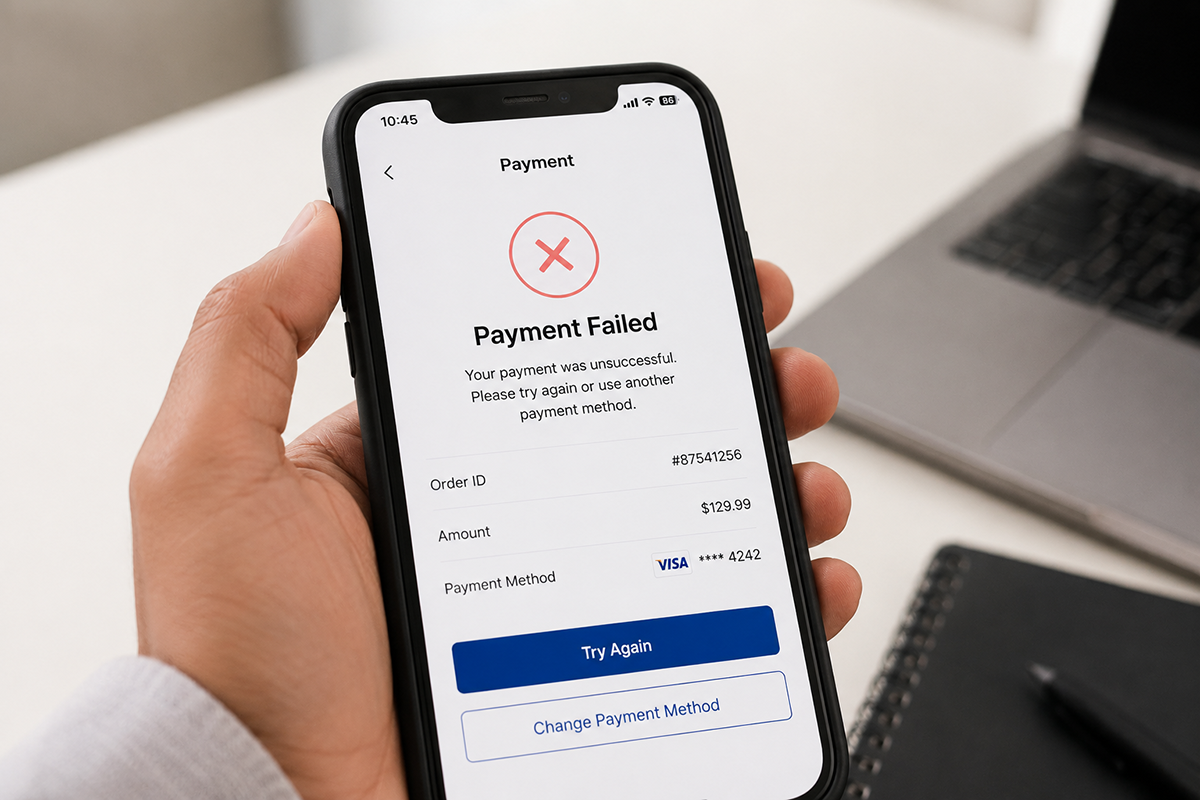
A customer completes the checkout process, enters their payment details, and selects the final confirmation button. The screen loads for several seconds before displaying an error. From the customer’s perspective, the payment has failed. Behind the interface, however, the transaction may already have been authorised or completed.
This uncertain state is one of the most challenging moments in a digital payment journey. The customer does not know whether to try again, wait for confirmation, contact support, or check their bank account.
When the payment experience cannot clearly explain what happened, customers may abandon the purchase, submit the payment again, or lose confidence in the platform. A transaction recovery system is designed to resolve this uncertainty before it becomes a financial or customer service problem.
A Failed Screen Does Not Always Mean a Failed Payment
Digital payments involve several connected systems. The customer interface communicates with the application server, payment gateway, acquiring bank, card network, issuing bank, fraud detection service, and merchant order system.
A delay or interruption at any point can prevent the interface from receiving a final response. The payment may have been approved by the bank even though the application timed out before receiving the confirmation.
This creates an ambiguous transaction state. The system cannot immediately confirm success, but it also cannot safely classify the payment as unsuccessful.
Why Payment Uncertainty Damages Trust
Customers expect payment experiences to provide immediate and definitive outcomes. They want to know whether money has been charged, whether the order has been created, and what they should do next.
Generic messages such as “Something went wrong” transfer the entire burden of uncertainty to the customer. The user must investigate the transaction without understanding whether the problem occurred in the website, payment gateway, bank, or network.
Even when the issue is temporary, the experience can make the entire platform appear unreliable. Payment trust is difficult to build and very easy to damage.
“A payment experience should never force the customer to guess whether their money has moved.
The Role of Transaction Recovery Systems
A transaction recovery system tracks payment attempts across every stage of the process. Instead of relying only on the response shown inside the browser or mobile application, it continues checking the payment status through the server and payment gateway.
When a final response is delayed, the system can query the gateway, verify the transaction reference, compare payment records, and update the associated order once the confirmed status becomes available.
This allows the platform to recover transactions that were completed financially but not correctly reflected inside the customer experience.
Preventing Duplicate Payments
One of the most serious consequences of an unclear payment result is an accidental duplicate transaction. When customers see an error, their natural response is often to select the payment button again.
If the original transaction was already processed, the second attempt may create another charge. This generates refunds, support cases, reconciliation work, and significant frustration for the customer.
Payment systems can reduce this risk by assigning a unique transaction reference to each checkout attempt and using idempotency controls. These controls ensure that repeating the same request does not create multiple financial transactions.
Designing an Honest Recovery Experience
The interface should distinguish between a confirmed failure and a payment that is still being verified. These are not the same situation and should not be communicated using the same message.
When the result is uncertain, the customer should see a clear message explaining that the payment is being checked. The interface should discourage immediate retries while providing a visible reference number and an expected confirmation timeframe.
Once the status is confirmed, the customer can be updated through the website, mobile application, email, SMS, or another appropriate communication channel.
Recovery Should Continue Beyond the Browser
Payment verification should not depend on the customer keeping the checkout page open. Users may close the browser, lose connectivity, refresh the page, or move to another application before confirmation is received.
Recovery must therefore operate on the server. Background processes can continue checking unresolved transactions and update the order independently of the customer session.
This creates a more resilient payment experience because the outcome does not depend on the stability of the customer’s device or network connection.
Reconciliation Protects Financial Accuracy
Automated recovery should be supported by regular reconciliation. Reconciliation compares payment gateway records, bank settlements, transaction logs, and merchant order data to identify inconsistencies.
For example, a payment may appear as successful in the gateway but remain pending in the order management system. Another transaction may be marked as failed internally even though the customer’s account was charged.
Detecting these differences early allows the business to correct orders, initiate refunds, update customers, and maintain accurate financial reporting.
Not Every Failed Payment Should Be Retried
Intelligent recovery does not mean repeatedly submitting every failed transaction. Some failures are temporary, while others require the customer to take action.
Network interruptions, gateway timeouts, and temporary service unavailability may be suitable for controlled retry logic. An expired card, incorrect security code, insufficient funds, or declined authorisation normally requires a different response.
The recovery strategy should interpret the failure reason and decide whether to retry, verify, request new information, suggest another payment method, or close the transaction safely.
Payment Recovery Is Also a Revenue Strategy
Every unresolved transaction creates a risk of lost revenue. A customer who has already completed the purchase journey may abandon the order simply because the final payment state was not communicated correctly.
Recovery systems help businesses retain valid transactions, reduce unnecessary checkout abandonment, prevent duplicate charges, and lower the volume of payment-related support requests.
The commercial value is not created by forcing more payment attempts. It comes from resolving uncertainty accurately and helping legitimate customers complete their intended purchase.
Measuring Payment Recovery Performance
Businesses should monitor more than the overall payment success rate. They should also measure the number of ambiguous transactions, recovered payments, duplicate attempts, delayed confirmations, reconciliation mismatches, and payment-related support cases.
These indicators reveal where the payment journey is creating uncertainty and whether the recovery process is successfully protecting customers and revenue.
Monitoring should also identify patterns by payment method, bank, device, browser, gateway, transaction value, and geographic region. This helps teams distinguish isolated incidents from recurring integration or infrastructure problems.
Build for Uncertainty, Not Only Success
Most payment experiences are designed around two expected outcomes: success or failure. Real payment systems are more complex. They also produce pending, delayed, interrupted, duplicated, reversed, and partially confirmed states.
A reliable payment platform must be designed for these uncertain conditions from the beginning. Clear status handling, unique transaction references, idempotent requests, server-side verification, reconciliation, controlled retries, and transparent communication should operate as one connected system.
The best payment experience is not simply one that processes successful transactions quickly. It is one that remains clear, accurate, and trustworthy when the expected process does not go exactly as planned.